






Homeward Pet Blog
catopia 2025

Helping Your Newly Adopted Cat Feel at Home:
A Gentle Guide to Building Trust, Routine & Safe Spaces
 The First Few Days: Setting the Stage for Comfort and Security
Bringing home a newly adopted cat is an exciting and emotional moment, but it’s important to remember that while this may feel like the start of something beautiful for you, your cat is experiencing a major life change. Everything smells different. The sounds are unfamiliar. Even the people are new. That’s why starting slow is one of the most compassionate things you can do.
In the first few days, your goal isn’t to get your cat to explore or play, it’s simply to help them feel safe.
Start by preparing a quiet, enclosed room where they can decompress at their own pace. Think of it as their “base camp.” This space should include:
- A cozy bed or blanket where they can burrow or hide
- Fresh water and food placed in a corner (not too close to the litter box)
- A clean litter box with easy access
- A scratching post or pad for stress relief and marking behavior
- A hiding spot like a covered bed, cardboard box, or even an open carrier with a blanket inside
Avoid overwhelming your cat by giving them access to the entire house right away. While it may be tempting to show them all the love and attention they’ve been missing, too much space too soon can trigger stress and make them retreat even more. Let them come out of hiding when they’re ready, some cats will venture out in hours, others may take days.
 Reading Their Cues: Let Your Cat Set the Pace
Every cat has their own way of adjusting, and learning to speak their language is one of the most meaningful ways you can support them. During the early days, your cat may not meow, cuddle, or play right away. But they are communicating. You just need to know what to look for.
Body language is a cat’s first and most honest form of expression. A tucked tail, wide eyes, flattened ears, or crouching posture may signal fear or uncertainty. Hiding under the bed or in the closet is normal and not a rejection, it’s self-protection. On the other hand, a slow blink, relaxed body, or curious sniffing from a distance may show that they’re starting to feel safe.
To gently build trust, try these low-pressure ways to connect:
- Sit quietly nearby – Just being present helps them get used to your scent and presence.
- Avoid direct eye contact – A soft gaze or slow blink is more comforting than a stare.
- Offer treats from a distance – Place them nearby and let your cat decide if and when to approach.
- Talk softly – Your voice can become a familiar comfort without requiring interaction.
- Don’t force physical contact – Let your cat make the first move when they feel ready.
 Establishing a Calming Routine
Cats are creatures of habit. When everything in their world feels new and unpredictable, like during the first days in a new home, a consistent routine can be one of the most comforting gifts you can give.
Routine reduces anxiety by helping your cat know what to expect. Predictable patterns create a sense of control, and that sense of control builds confidence and trust.
Here’s a simple daily structure to help your new cat settle in:
- Feeding Times: Serve meals at the same times every day (morning and evening are ideal). Regular meals create a rhythm and let your cat know they’re cared for.
- Play Sessions: Dedicate 10–15 minutes a couple of times a day to interactive play. Use wand toys or feather teasers to mimic “hunting” and burn off nervous energy.
- Clean Litter Box Daily: A clean litter box isn’t just hygiene, it’s a signal that their environment is safe and maintained.
- Quiet Time: Build in peaceful, undisturbed time where your cat can nap, watch the world, or retreat to their safe space without interruption.
- Gentle Interaction: Try talking softly to your cat at the same times each day (like before feeding or bedtime) to create reassuring verbal rituals.
Keep in mind, it’s less about what you do and more about how consistently you do it.
 The Power of Alone Time: Why Solitude Can Be Healing
While it’s tempting to shower your newly adopted cat with love and attention, sometimes the best gift you can offer is space.
Many rescue cats have been through overwhelming experiences, whether it’s time spent in a shelter, on the streets, or in multiple homes. The adjustment to a new environment, no matter how loving, can stir up anxiety. That’s why intentional alone time is so important.
Creating designated, low-traffic areas where your cat can retreat without pressure or interruption helps them regulate stress and recharge. These safe havens provide a sense of control, which is essential for emotional healing.
Here are some calming retreat ideas to offer your cat:
- Covered beds or cat caves – Ideal for cats who like dark, enclosed spots to hide and rest.
- Vertical spaces – Wall shelves or cat trees give shy cats a high vantage point to observe from a safe distance.
- Cozy hideouts – Even a simple cardboard box with a blanket can offer a much-needed sense of security.
- Outdoor escape (enclosed catio) – For cats who enjoy fresh air and quiet time in nature, a catio (a secure outdoor enclosure) can be the perfect sanctuary.

H2: Enrichment Builds Confidence
When a cat enters a new home, everything feels uncertain. Enrichment helps bridge that gap, giving them activities that not only distract from anxiety but also help them feel more in control of their environment.
Think of enrichment as giving your cat healthy “jobs” that engage their natural instincts: stalking, chasing, sniffing, scratching, and problem-solving. These activities burn off nervous energy, boost confidence, and promote a sense of normalcy in an unfamiliar space.
 Here are simple enrichment ideas to get started:
- Puzzle feeders – Make mealtime more rewarding by turning it into a mini hunt.
- Interactive toys – Wand toys, feather teasers, or battery-powered mice let your cat safely “hunt” and play.
- Scent games – Hide treats around their safe room to spark curiosity and exploration.
- Scratching posts – Vertical or horizontal options help them mark territory and relieve stress.
- Background sounds – Soft music, cat TV, or even a bubbling fountain can offer soothing stimulation.
 A Journey of Trust and Patience
Welcoming a newly adopted cat into your life is an act of love, and like any meaningful relationship, it takes time to grow. Some cats may warm up within days, while others need weeks or even months to truly settle in. Wherever your cat falls on that spectrum, know this: every small step forward is a victory.
Whether it’s the first time they venture out from hiding, the first soft purr, or the moment they choose your lap for a nap, these moments are worth celebrating. They’re signs that your cat is beginning to feel safe, seen, and at home.
By offering them calming spaces, consistent routines, and plenty of patience, you’re giving your cat everything they need to thrive.
The bond you’re building takes time, but it’s one rooted in trust. And that trust, once earned, becomes the heart of a lifelong friendship.
2024 Impact Report


Your Compassion in Action
In 2024, your compassion and generosity made an extraordinary difference. Thanks to you, more animals found safety, healing, and loving homes—and more families were supported in keeping their beloved pets healthy and by their side.
Our Annual Report is a celebration of what we accomplished together this past year. Inside, you’ll find stories of transformation, lifesaving milestones, and the real impact your support has on animals and people in our community every single day.
You are part of a community that believes every animal deserves safety, care, and love. From all of us at Homeward Pet—thank you for making 2024 a year of hope and healing.
Together, we’re building a future where every pet has a home.
Read the full report and see the lives you’ve changed.
After seeing the incredible impact we’ve made together, we hope you feel the same pride we do. Every animal rescued, every family united, every life saved—it all starts with you.
Your support powers:
- Lifesaving medical care for sick and injured animals
- Spay/neuter surgeries and vaccines for pets in underserved communities
- Safe shelter, love, and second chances for thousands of cats and dogs
- Adoption and foster programs that match pets with their perfect families
But there’s still so much more to do. Be a part of what’s next!
Right now, more animals are coming through our doors in need of urgent care, stability, and hope. Your gift today will help us continue to answer their calls for help—and ensure that the stories in next year’s report are even more inspiring.
Make your gift today and be part of the next chapter in this life-saving work.
From all of us at Homeward Pet—thank you for standing with us.
Kitten Development
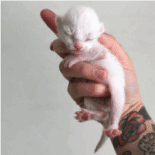

At Homeward Pet, we have taken in kittens as young as 1 day old and kittens who both have and don’t have mothers that are still caring for them. When we take in kittens who are too young to be adopted, they go straight out to foster care until they are ready. This is the best way to ensure that these fragile little beings are properly socialized. Most kittens do not spend more than a week in the shelter.
Have you ever considered fostering a litter of kittens? Here is what you can expect at each of their formative weeks.
 The First Week
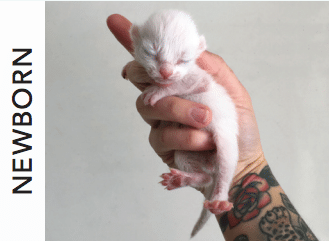
Newborn kittens are incredibly vulnerable. They are born blind, deaf, and unable to regulate their own body temperature or eliminate waste independently. Tiny enough to fit in the palm of your hand, they weigh just 3-5 ounces. At this stage, they are entirely reliant on their mother for protection, warmth, and nourishment. Despite their helplessness, they can purr and vocalize distress. They spend most of their time sleeping, waking primarily to eat, as they have significant growth ahead.
During their first week, kittens cannot stand. Their eyes remain closed, and their ears are folded. Orphaned kittens this young require round-the-clock care, including bottle feeding every two hours—yes, even through the night! Their senses of smell, hearing, and taste begin to develop.
By about one week of age, kittens become slightly more aware of their surroundings. Their eyes are nearly open, though their vision remains unfocused, and they have typically doubled their birth weight. Their ears also start to unfold.
 The Second Week
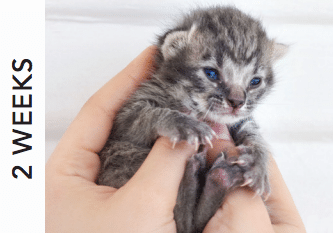
Kittens continue to grow rapidly during their second week. They huddle together for warmth and comfort, rarely straying far from their mother, their nest, or each other. Their eyes remain blue, a color that persists for the first few weeks, with their true eye color not fully apparent until around two months old. As their sense of smell develops, they may hiss at unfamiliar scents or sounds, though their tiny vocalizations are often more endearing than ferocious! They also begin kneading, though their claws are not yet retractable.
The Third Week
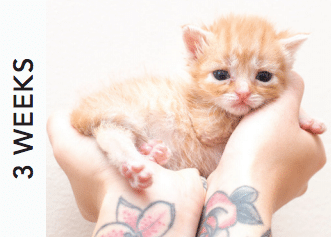 By the third week, you can often distinguish between male and female kittens. Their teeth begin to emerge, and their walking becomes more confident. This is a good time to introduce a litter box and wet food. Even at this age, kittens still sleep for a substantial portion of the day. They also start to eliminate waste independently, a significant milestone that signals the beginning of litter box training.
If you’re bottle-feeding, you’ll notice kittens drinking more at each feeding, but less frequently—typically four to five times a day. You can also begin introducing solid food, starting with wet food mixed with kitten formula. By the end of this week, they will weigh close to 15 ounces and walk steadily with much less wobbling.
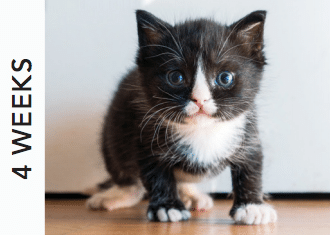 During the Second Month
At four weeks old, kittens are sturdy on their feet and engage in playful interactions with each other, toys, and people. Their fur begins to fill out, and you may start to tell whether they will have short, medium, or long coats.
This is a particularly fun age! With their sight fully developed, kittens engage in vigorous and exhaustive play, running and exploring until they literally fall asleep wherever they are. While they are experimenting with solid food, most kittens still nurse from their mother (or are bottle-fed by you) a few times a day. Human interaction is crucial for kittens at this stage. Consistent handling and play from people help them associate positive experiences with humans, which is vital for their successful adoption into new homes. Kittens also begin to exhibit instinctual behaviors like stalking, hiding, pouncing, and digging—behaviors ingrained in all cats, whether they grow up indoors or outdoors.
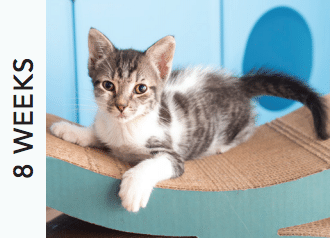 By the end of the second month, kittens will be almost fully weaned. Introducing them to new people, different areas of the home, and other pets is an important part of their socialization. At this point, they are fairly self-sufficient.
Ready for Adoption
At Homeward Pet, we have taken in kittens as young as 1 day old and kittens who both have and don’t have mothers that are still caring for them. When we take in kittens who are too young to be adopted, they go straight out to foster care until they are ready.
Considering opening your home to a litter of foster kittens? It’s a rewarding experience that makes a huge difference in their development and lives.
Not ready to foster or adopt? Please consider a donation to help us care for these fragile beings over the coming year. Make your donation recurring by clicking the tab to make it a monthly gift.
Please note that, if you are having difficulties seeing the form below, turn your browser pop up blocker off. Note that the form scrolls within itself to get to all the fields.
excerpted from a story written by Alley Cat Allies
photos courtesy of The Kitten Lady
Let’s Change Lives Together 🐾 – GiveBIG and give them a second chance.

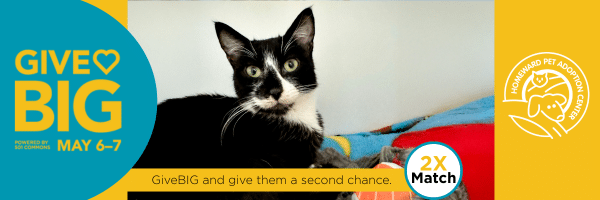
At Homeward Pet, we believe every life is worth saving—even when the road to recovery is long, complicated, and expensive. This GiveBIG, your generosity makes a meaningful difference for pets like Marlin, who need more than just shelter.
Marlin joined Homeward Pet in December 2024. During his intake exam, he rubbed against the vet’s hands and purred contentedly. At six months old, he was drastically thin and malnourished. Our hope was that a few weeks of a healthy diet and a steady stream of love would be all it took to prepare this kitten for his forever life.
While at the shelter, he let the staff know that he was uncomfortable, and we were challenged to keep him eating. His sweet nature had volunteers flocking to his kennel to try unsuccessfully to find treats or a food combination that would entice him. He always leaned in for the love but away from the food with that wrinkle to his nose that only cats will make. You know the one.
As his time with us stretched into the holidays, Marlin’s weight stayed critically low, and his spirit showed weakness between the purrs. A staff member offered to take him home to see if that would help. His time in foster included sleeping on his foster dad’s chest, and requesting cheek rubs from his foster mom. However, he didn’t show the verve one would expect from a kitten and struggled to explore his playful side.
Marlin came to visit our clinic often and was tested for any disease that might be causing his symptoms. Our staff consulted with multiple outside vets and researched conditions that might be less common. Marlin bravely leaned into the tech’s fingers for scritches while blood was drawn and curled into a volunteer’s waiting arms while his prognosis was discussed.
Marlin spent months in foster care. In February, it seemed like the combination of meds and supplements prescribed had finally gifted our gentle boy with a reprieve. He started to play; he jumped for the first time after a wand toy, and spent calculated time figuring out how to escape his foster room.
He was brought back to the shelter in hopes that we were close to being able to list him for adoption. Volunteers welcomed him home with cheers and open arms. Despite his playful nature and hopes for his healing, he started to show pain in his mouth, which culminated in the removal of five of his teeth. Unfortunately, the upward trajectory of his health was not to be and his mouth has continued to become more swollen and more painful. He struggled again to eat. His treasured face scritches started to cause him to flinch.
After thoughtful tests, he has been diagnosed with stomatitis, which is a severe inflammation of the mouth that can affect up to 4% of cats. It is a painful condition where the immune system overreacts to the bacteria in dental plaque, leading to inflammation and ulceration. Most often, the only cure is to remove the source of the plaque – the teeth. Yes, all of his teeth. Thankfully, Homeward Pet has had several litters of kittens where this was the diagnosis, and has a staged plan in place to ensure that the best decisions are made for the long term health of cats with this horrible condition.
Poor Marlin is now only ten months old but has spent his entire life battling mysterious ailments. Despite the pain he’s feeling, he continues to be a bright spot in our day, every day, giving us reasons to laugh and celebrate his silly personality. He still greets every volunteer with a purr and gentle taps with his paw. He patiently allows our clinic staff to poke and prod, confident that they have his best interests at heart. Not once has he growled, swatted, or been cranky about his care.
Marlin’s story reminds us why our work—and your support—matters so much. He’s still fighting, and so are we. When a pet arrives sick, injured, or in distress, they don’t know what’s coming next—but together we can make sure what comes next is healing, compassion, and hope.
Your GiveBIG gift isn’t just a donation. It’s a lifeline for pets like Marlin, ensuring that we never have to say “no” to an animal in pain because of cost or the time it takes to find a cure.
Your gift will be put to immediate use to treat, heal, and comfort more than 1,500 pets’ that come through our doors this year, including Marlin’s continued care. Thank you for being a part of our mission, and for giving animals like Marlin the care they deserve.
There’s still time to have your gift go TWICE as far this GiveBIG! Thanks to a generous matching grant, all donations will be matched dollar for dollar until midnight.
Give now. Give hope. GiveBIG.
Entries by Month
- February 2026
- January 2026
- December 2025
- October 2025
- August 2025
- July 2025
- June 2025
- May 2025
- March 2025
- January 2025
- December 2024
- November 2024
- October 2024
- July 2024
- January 2024
- November 2023
- October 2023
- July 2023
- June 2023
- February 2023
- January 2023
- November 2022
- September 2022
- August 2022
- May 2022
- February 2022
- November 2021
- October 2021
- August 2021
- July 2021
- June 2021
- May 2021
- April 2021
- March 2021
- February 2021
- December 2020
- November 2020
- October 2020
- September 2020
- July 2020
- June 2020
- May 2020
- April 2020
- March 2020
- February 2020
- January 2020
- December 2019
- November 2019
- October 2019
- September 2019
- August 2019
- July 2019
- June 2019
- May 2019
- March 2019
- January 2019
- December 2018
- November 2018
- October 2018
- September 2018
- August 2018
- July 2018
- June 2018
- May 2018
- April 2018
- March 2018
- February 2018
- January 2018
- December 2017
- November 2017
- October 2017
- September 2017
- August 2017
- July 2017
- June 2017
- May 2017
- April 2017
- March 2017
- February 2017
- January 2017
- December 2016
- November 2016
- October 2016
- September 2016
- August 2016
- July 2016
- June 2016
- May 2016
- April 2016
- March 2016
- February 2016
- January 2016
- December 2015
- November 2015
- October 2015
- September 2015
- August 2015
- July 2015
- June 2015
- May 2015
- April 2015
- March 2015
- February 2015
- January 2015
- December 2014
- November 2014
Phone:
Our Address:
Tax ID#:
Mon-Sun, 12:00pm - 2:30pm and 3:30pm - 5:00pm
425.488.4444
P.O. Box 2293
13132 NE 177th Place
Woodinville, WA 98072
91-1526803



